
Pergola Creations
Are beautiful buildings enough in a changing climate?
The value of architecture has changed. Today, a building must do more than look impressive. It must perform. In a rapidly changing climate, good design should not be measured solely by aesthetics but by its ability to respond to rising temperatures, increasing flood risks, growing energy demands, water scarcity, food insecurity, and the need for long-term resilience. All of which are the effects of global warming and climate change.
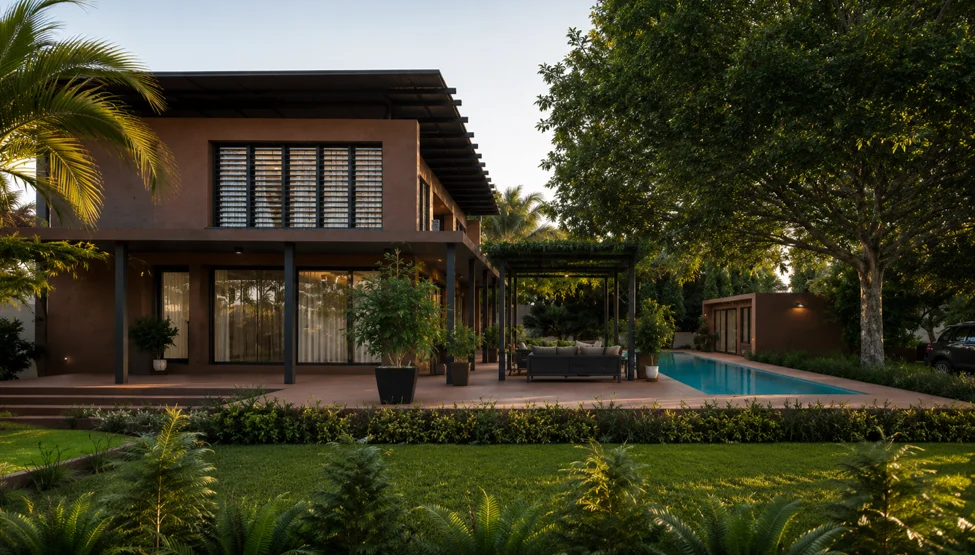
Context: Climate-smart architecture
Source: Pergola Creations
For many years, architecture was often judged primarily by appearance. A beautiful façade, a grand entrance, or a striking interior was enough to suggest that a building had been well designed. But as climate change reshapes the way we live and interact with our built environment, beauty alone is not sufficient. A truly well-designed building must be climate-smart, capable of protecting its occupants, conserving resources, adapting to changing conditions, and remaining comfortable and functional for years to come.
Good architecture is often misunderstood. To some, it is about drawings. To others, it is about style, luxury or visual appeal. But architecture is much deeper than that. It is the careful organisation of space, structure, comfort, safety, function and meaning.
Designing for rising Heat
In warm climates, thermal control is one of the most important design considerations. A poorly designed building can trap heat throughout the day, making rooms uncomfortable. This often leads to heavy dependence on air conditioning, fans, and artificial cooling systems, thereby increasing electricity costs.
This pressure is lessened by good architecture. A building can be constructed to more intelligently control heat by appropriate orientation, shading, ventilation, roof design, and material choices. This implies lessening needless reliance on cooling systems.
It will be more comfortable to live in a climate-responsive building that adapts to rising temperatures. Over time, it will also become more durable and energy-efficient.
Rainfall Cannot Be Overlooked
Poor drainage, unsuitable site planning, and heavy hard landscaping, most commonly seen in urban cities, create serious problems for buildings. The situation is even worse with the erratic rainfall patterns we experience nowadays. Buildings should not be designed out of context as if they were standalone structures, but rather be designed as part of the larger environment. When buildings are designed as one in nature, interacting and complementing each other in such a way that neither poses a threat to the other. The relationship between a building and its surroundings matters a lot.
A good design considers ground levels, drainage, roof water management, landscape planning and how water moves around the development. These decisions may not always be visible in the final photographs, but they are essential to the building’s performance.
Ignoring water at the design stage can create expensive problems later.
The Floods Should Not Be Left Out

Context: Flooding in Accra.
Source: Pergola Creations
Across Ghana’s cities, poor drainage planning and construction on natural water channels have turned seasonal rains into recurring disasters, damaging homes that were otherwise well designed. Architecture that photographs beautifully but ignores site hydrology, stormwater management, and flood-resilient siting is only solving half the problem. Real design excellence today has to hold both truths at once — that a building should be beautiful, and that it should also survive, and even help mitigate, the water crises shaping the climate it sits in. Leaving floods out of the design conversation isn’t an oversight; it’s a failure of the brief itself.
Good Design Protects Long-Term Value
A building is a long-term investment, and poor design doesn’t stop costing you once construction ends. The consequences linger. They show up as daily discomfort, endless repairs, high energy bills, wasted space, and a property that loses value over time.
Climate change only sharpens these weaknesses. Poor ventilation makes a space harder to inhabit. Poor drainage turns heavy rainfall into a liability. Weak material choices age faster than they should. Poor orientation invites unnecessary heat.
Good architecture will not eliminate every risk, but thoughtful planning goes a long way toward preventing problems that were always avoidable.
Architecture Must Serve People First
Climate-responsive architecture is not only about the environment. It is also about people.
People need comfortable homes, offices that support productivity, schools that are safe and breathable, and public spaces that feel usable. They need buildings that do not punish them with heat, darkness, poor circulation, or constant maintenance issues.
When architecture responds well to climate, it improves the human experience. This is why design matters. It shapes how people sleep, work, gather, rest, and move through their day.

Context: Comfort through climate – responsive design.
Source: Pergola Creations
The Future of Building Must Be Smarter
As the climate changes, buildings can no longer be designed as though the environment is an afterthought.
Buildings of the future need to be more thoughtful, more practical, and more responsive to their environmental conditions. They need to bring beauty, performance, and resilience together, not treat them as separate goals.
This does not mean every building should look alike. It means every building should be shaped by sharper, more deliberate thinking. A beautiful building that fails in its climate is not enough.
Final Thought
Good architecture matters more in a changing climate because buildings are no longer judged only by how they look. They are judged by how well they protect, support and serve the people who use them. The best architecture is not just beautiful. It is responsive, resilient and deeply aware of its environment.
In today’s climate, good design is not optional. It is essential.